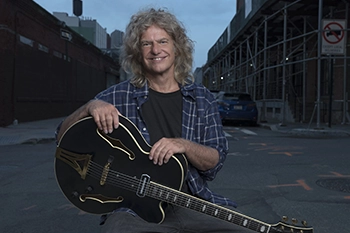
Pat Metheny Side-Eye III+
Pat Metheny Side-Eye III+ Pat Metheny (guitars), Chris Fishman (keyboards), Joe Dyson (drums), Jermaine Paul (bass) Pat Metheny is probably the most influential and charismatic jazz guitarist of recent decades. With a career spanning more than half a century, he has achieved something that very few musicians can claim: to constantly reinvent the sound of his instrument without ever losing his identity. His music, at once luminous and complex, moves between melodic warmth and harmonic exploration, between the freest improvisation and the most detailed composition. Born in 1954 in Kansas City into a family of musicians, Metheny began playing the trumpet at the age of eight, before discovering at the age of twelve that the guitar would be his definitive instrument. Still a teenager, he was already playing with the best jazzmen in his hometown, absorbing the pulse of the blues and the swing tradition that would mark his style forever. At the age of just twenty, he made the leap to the international scene alongside vibraphonist Gary Burton, and from then on, his name was associated with a new way of understanding jazz guitar: a smooth and flexible playing, a rhythmic and harmonic sensitivity ahead of its time, and a boundless curiosity. His recording debut, Bright Size Life (1975), was a revolution. On that album, Metheny redefined the language of modern guitar and opened up a sonic horizon that inspired entire generations. From then on, his career unfolded in multiple directions: from experimenting with technology and synthesizers to composing works for large orchestras, ballets or small chamber ensembles. Metheny's versatility knows no boundaries. He has collaborated with figures as diverse as Steve Reich, Ornette Coleman, Herbie Hancock, Jim Hall, Milton Nascimento, David Bowie and the much-missed Lyle Mays, with whom he formed one of the most fruitful creative tandems in the history of modern jazz. Together they founded the Pat Metheny Group in 1977, a band that expanded the frontiers of the genre with its own aesthetic, winning seven consecutive Grammy Awards, something no other artist has ever achieved. Over the course of his career, Metheny has received more than twenty Grammy Awards in a dozen different categories, reflecting the breadth of his musical universe. But beyond the awards, what defines Metheny is his tireless search for new forms of expression. He has pioneered the use of the Synclavier and experimental guitars such as the 42-string "Pikasso"; he has conceived automated orchestra projects (Orchestrion); and, in recent years, he has continued to explore intimate and poetic territories on albums such as Dream Box (2023). Metheny has combined his activity as a performer and composer with intense pedagogical work. At the age of 19 he became the youngest professor in the history of the Berklee College of Music, and since then he has given classes and workshops all over the world, convinced that musical knowledge only makes sense when it is shared. For this concert at the Kursaal Auditorium, Metheny will present his Side-Eye III+ project. Side-Eye is a platform to host and support new generations of musicians, a rotating cast of artists performing new pieces and revisiting old music by Pat Metheny. Side Eye III+, the latest chapter of this project, will bring us three emerging musicians of proven quality: Chris Fishman (1997) is a pianist, composer and producer from Los Angeles who has played with Flying Lotus, Louis Cole and Mac Demarco; Joe Dyson (1990), a New Orleans-born drummer who began playing at the age of two and was trained by important musicians in his city; and Jermaine Paul (2001), a young Californian bassist who has already worked with artists such as MC Hammer, Macy Gray, Jaden Smith, Julius Rodriguez, Barbara Morrison and Munyongo Jackson, At 71, Pat Metheny remains a tireless innovator, a creator who does not repeat formulas but who, at the same time, maintains his coherence, proving that jazz, as well as a musical style, is also a way of understanding the world.
View on the original source →